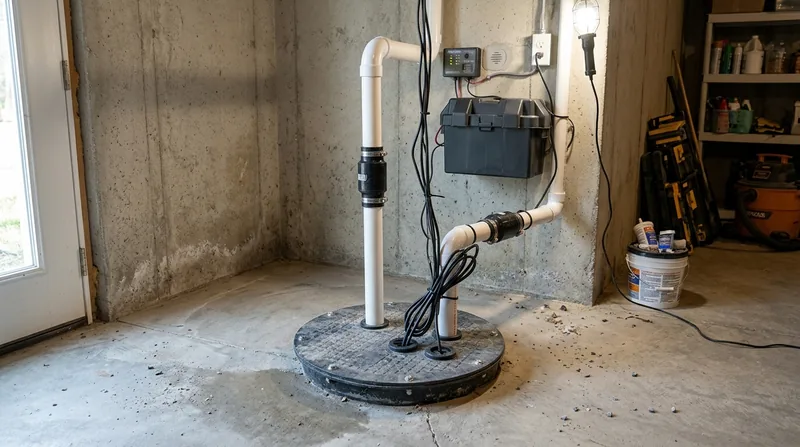




Battery Backup Sump Pumps in O'Fallon: Power Outage Protection for a Wet Basement
When a July thunderstorm rolls over the Dardenne Prairie edge and the power grid drops, your primary sump pump stops with it. That is exactly when the water table is highest and the sump basin is filling fastest. We install Battery Backup Sump Pumps in O'Fallon so the pit keeps discharging when the electricity does not. O'Fallon sits on silty loess and heavy glacial clay over shallow limestone and shale, ground that swells after spring rains and pushes water against block and poured walls alike. Older ranches near Old Town and the 1980s to 2000s subdivisions off Spencer Road and Highway K all rely on a working sump. A backup system buys you hours of pumping until the line crew restores service. If your wet basement already shows standing water after storms, start with a sump pump installation and replacement review before adding the backup.
Why O'Fallon Basements Need a Backup Pump, Not Just a Primary
The dominant failure mode here is not a dead pump motor, it is a dead circuit. Summer thunderstorms knock out power across St. Charles County in bursts, and ice storms in January do the same. A primary sump pump with no battery backup is a single point of failure sitting in the lowest corner of the house. The heavy clay holds water against the wall for days after the rain stops, so the pump keeps cycling long after the storm passes. That is the window where a backup earns its place.
- Power outages during hard summer storms stop the primary pump while the basin is still filling.
- Freeze-thaw cycles crack older block walls and increase seepage volume into the pit.
- Spring rains saturate the loess and clay, raising the water table for weeks at a time.
- Dardenne and Peruque creek flooding after cloudbursts overwhelms footing drains that were sized for normal rain.
- A tripped GFCI or a burned-out float switch takes the primary offline with no warning at all.
None of those failures announce themselves, which is why the backup has to be automatic and self-testing.
Key info: In the older block-basement neighborhoods near Old Town St. Charles and the 1950s to 1970s ranches around O'Fallon's core, we routinely find primary pumps on a circuit shared with a freezer or a bathroom GFCI. One trip and the pit floods. A dedicated circuit plus a battery backup closes that gap.
The U.S. Department of Energy's emergency preparedness guidance is a reasonable starting point for understanding how long backup power needs to last during an outage.
How We Size and Install a Backup System in an O'Fallon Sump Pit
Every install starts with the pit itself. A backup pump that out-pumps the basin or sits too high on the float is worse than useless. We measure pit diameter and depth, check the check valve and discharge line, and confirm the primary pump's float travel. Then we match the backup to the actual inflow you see during a storm, not to a catalog number.
- We inspect the sump basin, the check valve, and the discharge line for clogs or backflow before anything is mounted.
- We size the backup pump and battery to the pit volume and to the inflow your basement actually takes on.
- We mount the backup pump on its own float, set higher than the primary so it only runs when the primary fails.
- We run a separate discharge line or tie into the existing one with a dedicated check valve to prevent recirculation.
- We wire the charger to a live circuit and test the system under load before we leave.
- We set the alarm and walk you through the monthly test so you know the battery is holding charge.
A correctly installed backup runs silently for months and only proves itself on the night the grid goes down.
Local example: A split-level off Highway K in the 63366 zip had a primary pump that cycled every 90 seconds during a June storm. The inflow was too high for the pit, so we upsized the basin and added a backup sized to match. During the next outage the backup ran for four hours without the pit rising. That is the difference between a properly sized system and a box-store kit.
If the pit itself is undersized or the drain tile is failing, a backup alone will not keep up. In those cases we look at an interior drain tile system to manage the water before it reaches the basin.
Backup Pump Options We Install in O'Fallon Homes
There is no single right backup for every pit. A finished lower level in a 1990s subdivision off Spencer Road carries different stakes than an unfinished block basement near Josephville. The table below shows the approaches we use and where each one fits.
| Approach | Description | Best for |
|---|---|---|
| Battery backup pump with float switch | A DC pump on its own float, set above the primary, powered by a charged battery. | Most O'Fallon pits with a working primary and short outages. |
| Combination primary and backup unit | One housing with an AC primary and a DC backup sharing the same discharge. | Pits with limited space or older single-pump setups being replaced. |
| High-capacity backup with dual batteries | Extended runtime for pits that take heavy inflow during spring storms. | Finished basements and high-water-table lots near the creek corridors. |
| Backup plus high-water alarm | Audible alarm that trips if water rises past the backup's trigger point. | Homeowners who travel or want early warning of any pump failure. |
| Annual maintenance and load test | Battery load test, float check, and discharge line inspection each year. | Every installed system, especially before storm season. |
Battery Backup Sump Pumps Cost in O'Fallon: What to Expect
Most homeowners want a number before they book, and that is fair. Backup systems start at $900 for a standard DC pump, battery, charger, and float installed in an existing pit. That figure moves with pit condition, discharge routing, and how much runtime you need. A pit that needs a new basin or a dedicated circuit adds to the total. A finished basement that needs dual batteries for longer runtime sits at the upper end. We do not quote over the phone without seeing the pit, because a number pulled from the air is not a number you can plan around.
Two or three estimates is the smart approach here, same as any trade. Ask each contractor what battery capacity they are installing, whether the discharge is shared or separate, and what the runtime looks like at your inflow rate. The full range of work is listed on our pricing page so you can compare line items rather than lump sums.
Key info: A backup pump that costs a few hundred dollars less but uses a smaller battery will run out of power in a two-day ice-storm outage. Runtime is the spec that matters, not the sticker price. Ask for the amp-hour rating and the expected hours of pumping at your inflow.
Battery Backup Sump Pumps Near Me: How to Vet a Contractor in O'Fallon
Searching for a backup pump installer near O'Fallon returns a lot of names, and not all of them do this work every week. A general handyman can bolt a pump into a pit, but sizing the battery and routing the discharge correctly takes someone who does it routinely. Here is what to check before you sign anything.
- Confirm the contractor is licensed and insured, and ask for a certificate of insurance before work begins.
- Get two or three written estimates that list the pump model, battery capacity, and discharge routing.
- Ask for references from O'Fallon or St. Paul homeowners with the same basement type as yours.
- Ask whether the work needs a permit. Rules vary by jurisdiction, so verify with the local building department before scheduling.
- Check whether your subdivision or HOA has rules about exterior discharge routing or equipment placement.
A straight answer on all five points is a better signal than a low bid.
If you want the pit looked at before you decide, our contact page gets you a free inspection and a written estimate with no obligation to book. For homeowners in the 63368 zip, the O'Fallon 63368 service page covers the local details.
When a Backup Pump Is Not the Whole Answer
We are honest about this because it saves homeowners money. A backup pump protects against power loss. It does not fix a wall that is seeping after every rain, and it does not compensate for a failed drain tile or a pit that fills faster than any pump can clear. If you see efflorescence on the block or a musty smell in the lower level, the water is already getting in somewhere. In those cases we look at the whole system, including the footing drain and the wall itself, before recommending a backup. Sometimes the right answer is a foundation crack repair and a backup pump together. Sometimes it is a backup pump alone. The inspection tells us which.
Call (636) 466-8705 to schedule a free basement inspection in O'Fallon and the surrounding St. Charles County area.
Battery Backup Sump Pumps in O'Fallon: Pricing Guide
| Service | Price | Details |
|---|---|---|
| Standard battery backup system | Starting at $900 | DC backup pump, battery, charger, and float installed in an existing pit, tested under load |
| Combination primary and backup unit | Starting at $1,250 | Single housing AC primary plus DC backup, best when replacing an aging single pump |
| High-capacity dual-battery backup | Starting at $1,600 | Extended runtime for finished basements and high-inflow pits near creek corridors |
| Backup plus high-water alarm | Starting at $1,050 | Audible alarm that trips if water rises past the backup trigger point |
| Complex or large-scale job | On estimate | New basin, dedicated circuit, or separate discharge routing needs an on-site look first |
| Estimate | Free | Response within 24h at (636) 466-8705, no obligation to book |
Indicative pricing, the exact cost depends on square footage, finish, and site access. Free personalized estimate within 24h at (636) 466-8705.


